|
|
 George George Zoltan Lefton was a Hungarian immigrant who arrived in Chicago in 1939 and founded the Lefton Importing Company in 1941. The Lefton Company was
purchased by OMT Enterprises in 2005 and moved to California. Although Mr. Lefton's background was in marketing and designing specialty clothing, he had a passion
for collecting fine porcelain. That is probably why we see such beautiful Lefton mermaids clad in wonderful colors and outfits! Lefton imported many products from
Japan to sell under the Lefton label. Most had a Lefton label on the back of the piece, or on the box it was packaged. Over the years, those paper labels have been removed,
and boxes tossed. So now it is sometimes hard to identify which ones made in Japan were distributed by Lefton.
George George Zoltan Lefton was a Hungarian immigrant who arrived in Chicago in 1939 and founded the Lefton Importing Company in 1941. The Lefton Company was
purchased by OMT Enterprises in 2005 and moved to California. Although Mr. Lefton's background was in marketing and designing specialty clothing, he had a passion
for collecting fine porcelain. That is probably why we see such beautiful Lefton mermaids clad in wonderful colors and outfits! Lefton imported many products from
Japan to sell under the Lefton label. Most had a Lefton label on the back of the piece, or on the box it was packaged. Over the years, those paper labels have been removed,
and boxes tossed. So now it is sometimes hard to identify which ones made in Japan were distributed by Lefton. There was a Japanese company (owned by Kowa Toki) that Lefton became and those
pieces can be identified by a numeric inkmark beginning with "KW."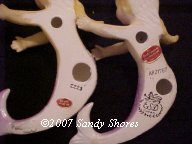
Then there is the ESD marking you often see. I have been given a number of stories about this ESD marking but in talking with Stuart Brown, a long time collector and researcher of Lefton, I
feel I've finally found the right answer! Stuart has been collecting Lefton and researching Lefton for about 16 years. I appreciate Stuart's time in helping me update this section on Lefton. Here
is some information Stuart shared with me on the ESD labeling..... Mr Lefton - George Zoltan Lefton - the founder of the company, had a friend in Canada that he let order from Lefton's
Japanese manufacturers at the same time as Lefton ordered so as to increase the number of items ordered and thus lowering the wholesale costs to both importers. Stuart refers to that as
"piggybacking"... ie, Mr Lefton let the fellow in Canada piggyback on some of his companies orders....Until they no longer were friends..
|
|
|
|
|
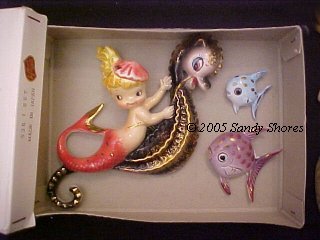
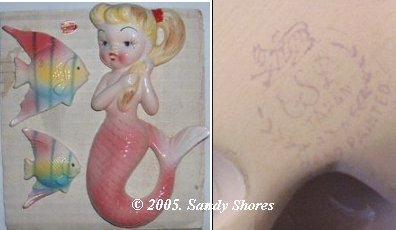 Here is another mermaid with the ESD marking. The mermaid and fish came glued to a card (as a lot of them did back then). The Lefton label is on the card, NOT on the mermaid. The
mermaid has the ESD inkstamp on the back.
Here is another mermaid with the ESD marking. The mermaid and fish came glued to a card (as a lot of them did back then). The Lefton label is on the card, NOT on the mermaid. The
mermaid has the ESD inkstamp on the back. Kelvin also distributed this mermaid, but it looked a little different. And I have seen this mermaid with just the Japan label
on the back where the painting wasn't done that good. So I imagine a lot of manufacturers were exporting the design of this one back in the 50's. Look in the Japan and Kelvin sections for other examples.
.
|
|
|
|
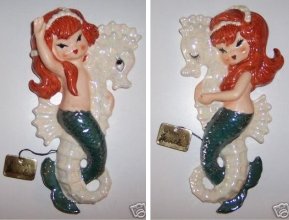
| This is another gorgeous set by Lefton. The red headed
mermaids on white pearlescent seahorses. What I just love about this set are the eyes - they are done differently than any of the other Lefton Mermaid eyes.
Plus the lips are really unique too! She was made by the Lefton designer Marika
who was known for her Lefton lady figurine designs. This set
you have the same problem with variations in tailfin colors as the 3 sister red headed set. Sometimes they are dark green,
sometimes light green, sometimes purple. So it is best to buy them as a set. The set above is the most pristine set I've seen of these two and they still have the tag with Marika's
name. |
|
|
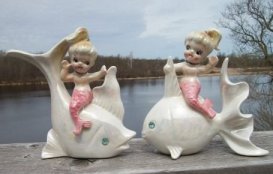
| Lefton distributed a set of 3 mermaids sitting on fish.
Each fish is in a different position. Note that Norcrest also made a set of 3 mermaids sitting on fish but their tailfins are blue. The Lefton mermaids on fish had a
pink tail. These mermaids can be hung on the wall, but can also sit on a counter. |
|
|
|
|
|
There were a number of sets made by Lefton that were bisque with a matte finish rather than a gloss finish. The bell is listed in
reference books as made by Lefton but you see a Jasco sticker on it a lot - I suppose they bought from Lefton and put their own
sticker on it. The set to the right is the Lefton Prince and princess set - the merboy even has a crown on his head.
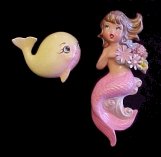  To the left is a reproduction I make of the blue tailed mermaid. I
often create her with a fish or whale as she looks like she is singing to them! I also have the mold for the pink tailed one and the prince and princess. To the left is a reproduction I make of the blue tailed mermaid. I
often create her with a fish or whale as she looks like she is singing to them! I also have the mold for the pink tailed one and the prince and princess.
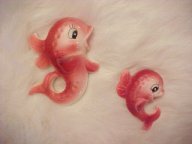
To the right are two little fish made by Lefton, think the largest one is 3" tall. They go so nice with mermaids on the wall as they are just so playful! |
|
|
|
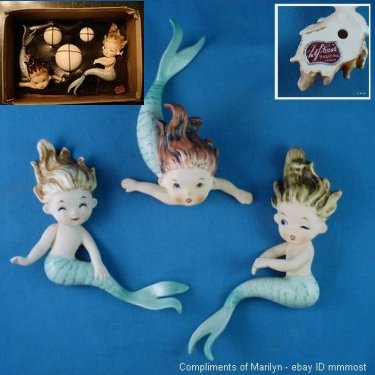
| This is a really pretty mermaid set and the tailfiins are kind of a
blue-green. They are so elegant looking in hand and are 5.5" tall. They came in a boxed set of two (top and right one) with the
KW60153 marking on the mermaids. Then there was a set with the 3rd one (on left) that each had the KW6960 marking. Along with the
inkmark, they either had a Made in Japan red label or Lefton red label. Bradley made a similar set that are smaller and have green
tailfins so don't get them mixed up with this set (see my Bradley section for what the Bradley ones look like). One note here, Stuart
researched the Lefton catalogues and only the two that came in the boxed set are shown in the Lefton catalogues. However, I have seen
the third one with the Lefton label as shown in the right top picture and have seen her with the KW6960 marking. So we are still
researching this mystery! Just be aware that the one on the left you don't see nearly as often as the other two. |
|
|
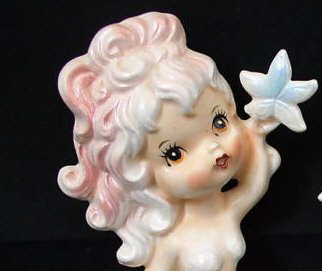 You don't see these mermaid that often. She is featured on the contents page of Arleen Smith's reference book. They can be hung on the wall but look better sitting
on a counter because of the thickness... especially at the bottom. She is not mentioned as distributed as Lefton but has that Lefton look.
You don't see these mermaid that often. She is featured on the contents page of Arleen Smith's reference book. They can be hung on the wall but look better sitting
on a counter because of the thickness... especially at the bottom. She is not mentioned as distributed as Lefton but has that Lefton look.
|
|
|
|
|
|
|
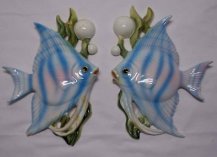 A lot of the manufacturers made fish so they could either sit on a counter or hang on the wall. This type fish up top looks good either was but gives the alternative of having fish running
around on the sink!
A lot of the manufacturers made fish so they could either sit on a counter or hang on the wall. This type fish up top looks good either was but gives the alternative of having fish running
around on the sink!The blue fish are pretty too! |
|
|
|
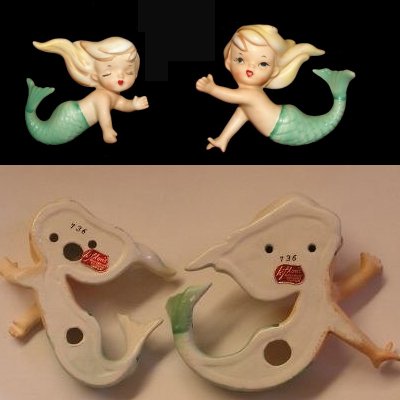
| This is a cute mermaid set with the 736 numeric marking and Lefton
label. They are really cute little mermaids! There is another set exactly like this with the numeric marking 11576. |
|
|
|
|
|

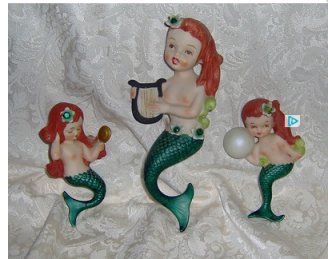 This is probably the first mermaid set people think about when they think of Lefton mermaids.
They were originally sold as a set but now you will often see them sold individually. The tailfin colors on this set vary dramatically so it's best to get all three together so you
can ensure their tailfins match. Some are almost a black/purple, some are more black/green, and then you see some that are primarily purple. The older sister
always has red hair but the little sisters came with red or blonde hair. There is one set, to the right, that has rhinestones in the flowers
and some lighter green bubbles or something (maybe it represents seaweed?) on them. The tailfins are more a metalic finish than pearl like the others.
This is probably the first mermaid set people think about when they think of Lefton mermaids.
They were originally sold as a set but now you will often see them sold individually. The tailfin colors on this set vary dramatically so it's best to get all three together so you
can ensure their tailfins match. Some are almost a black/purple, some are more black/green, and then you see some that are primarily purple. The older sister
always has red hair but the little sisters came with red or blonde hair. There is one set, to the right, that has rhinestones in the flowers
and some lighter green bubbles or something (maybe it represents seaweed?) on them. The tailfins are more a metalic finish than pearl like the others. 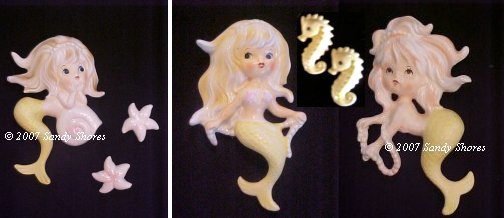
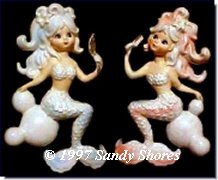
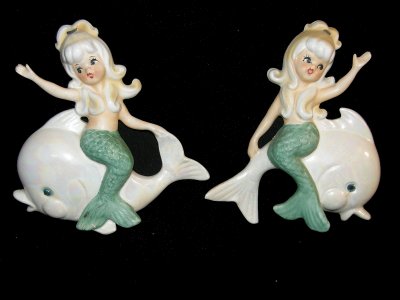
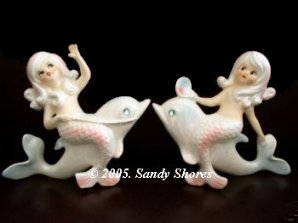 This is the
Lefton set of mermaids on dolphins. The dolphins have rhinestone eyes. This set is ceramic - there is another set you see of these two that was made in Janpan
out of plastic. These can hang on the wall or sit on a counter.
This is the
Lefton set of mermaids on dolphins. The dolphins have rhinestone eyes. This set is ceramic - there is another set you see of these two that was made in Janpan
out of plastic. These can hang on the wall or sit on a counter.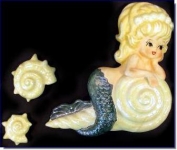 This is a pretty Lefton mermaid and she is rather a thick piece. She looks wonderful if you have a fish in front of her.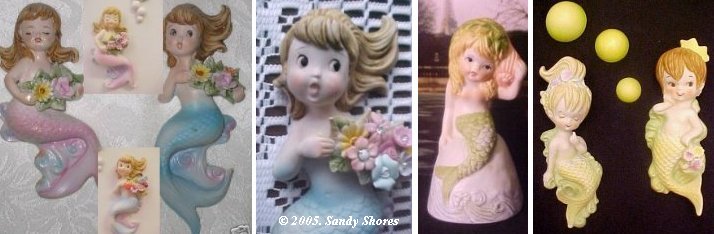
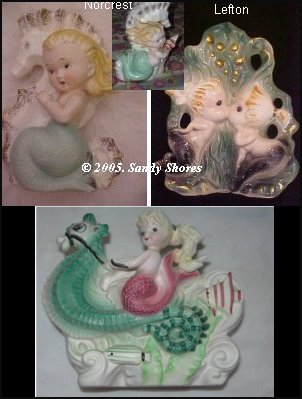
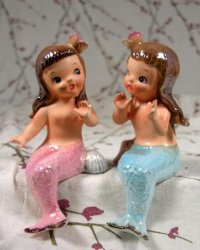
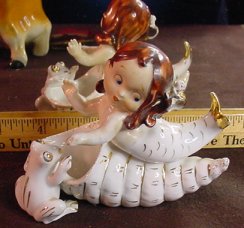 There are about 6 of these cute Lefton figurines that sit on something. They aren't very big but they sure are cute. You don't see
them come up for sale much and usually just as singles rather than the set of 6.
There are about 6 of these cute Lefton figurines that sit on something. They aren't very big but they sure are cute. You don't see
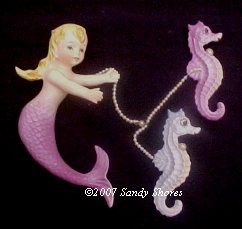
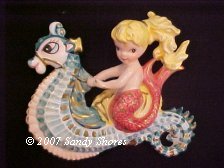
them come up for sale much and usually just as singles rather than the set of 6.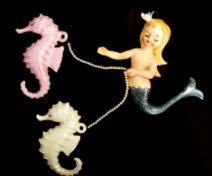 This is another Lefton mermaid and seahorse wall plaque. The seahorses came on a pearl chain. The mermaid is very similar to the 3 mermaid set with the redheaded mom holding a harp so
this set would go well mixed in with those.
This is another Lefton mermaid and seahorse wall plaque. The seahorses came on a pearl chain. The mermaid is very similar to the 3 mermaid set with the redheaded mom holding a harp so
this set would go well mixed in with those. 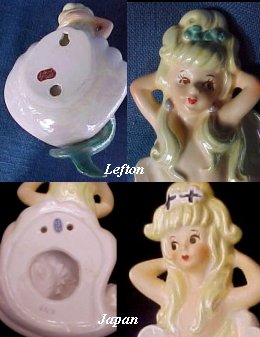
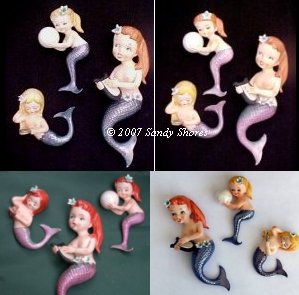
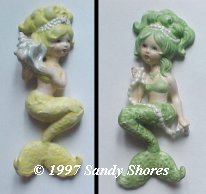
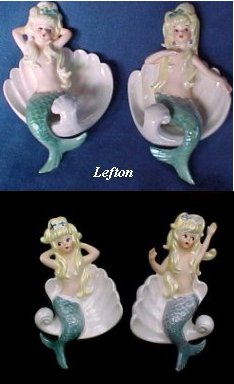 This Lefton set is really pretty and was made around the same time as the
mermaids on starfish. The top pictures are of the Lefton set. The bottom pictures are thought to be made in Japan for Lefton but I have never seen a Lefton label on them so they maybe someone
else distributed them. The ones distributed by Lefton have the Lefton sticker and no number. They have pearls in their hair and as earrings. The others
have what appears to be a starfish in the hair and they do not have any earrings. Both are pretty and in many cases the faces of the Japanese ones are cuter than
the Lefton. Both are pretty sets but the quality is a little better on the ones with the Lefton label and the tailfin seems to be a little lighter green on the Lefton ones.
This Lefton set is really pretty and was made around the same time as the
mermaids on starfish. The top pictures are of the Lefton set. The bottom pictures are thought to be made in Japan for Lefton but I have never seen a Lefton label on them so they maybe someone
else distributed them. The ones distributed by Lefton have the Lefton sticker and no number. They have pearls in their hair and as earrings. The others
have what appears to be a starfish in the hair and they do not have any earrings. Both are pretty and in many cases the faces of the Japanese ones are cuter than
the Lefton. Both are pretty sets but the quality is a little better on the ones with the Lefton label and the tailfin seems to be a little lighter green on the Lefton ones.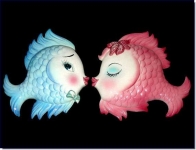
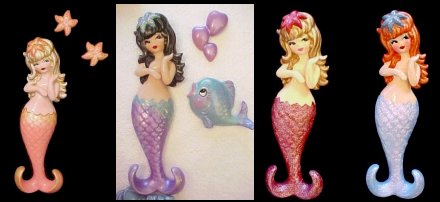
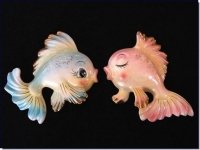 Here are a couple sets of Lefton fish. The set to the left
came with a set of heart shaped bubbles and the colors are very bright and vivid.
Here are a couple sets of Lefton fish. The set to the left
came with a set of heart shaped bubbles and the colors are very bright and vivid. 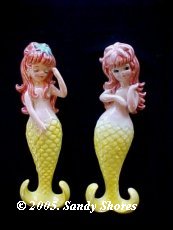
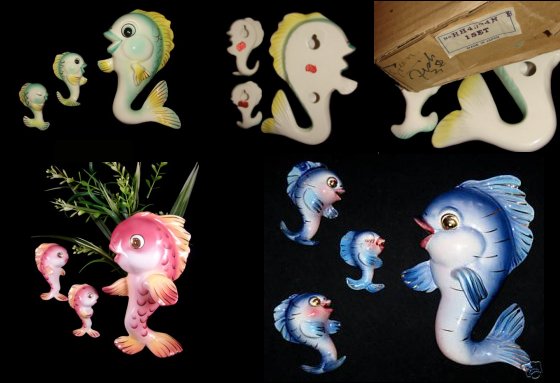 This is the Lefton mom and baby fish set. It came in all sorts of colors. The set included a large mom and 3 babies, although you see the set sold a lot of times with just one or two babies...
and even see them sold individually. The mom is quite large but the small baby is only about 2" tall. The pictures show a yellow/green set with the box. Although the set has the
original box, it is still missing one of the babies. I just mention this because I see a lot of people buying sets and paying high dollar because they have the original box and think everything is
there that should be and they are in pristine condition. But there is no quarantee that having the original box will give you all the pieces, or the set in printine condition.
This is the Lefton mom and baby fish set. It came in all sorts of colors. The set included a large mom and 3 babies, although you see the set sold a lot of times with just one or two babies...
and even see them sold individually. The mom is quite large but the small baby is only about 2" tall. The pictures show a yellow/green set with the box. Although the set has the
original box, it is still missing one of the babies. I just mention this because I see a lot of people buying sets and paying high dollar because they have the original box and think everything is
there that should be and they are in pristine condition. But there is no quarantee that having the original box will give you all the pieces, or the set in printine condition. 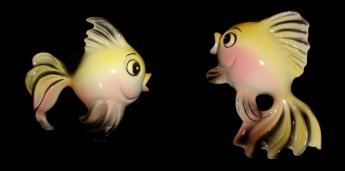
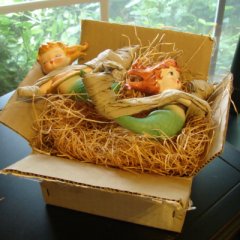 This is such a pretty mermaid set and has a polynesian/hawaiian look as their tops look like
they are made of straw. The set came in a box with straw and each arm and tailfin was carefully wrapped before boxing. I love finding these sets
in the original box with all the pieces! This set is very beautiful hanging on the wall the colors are very dynamic and the details are beautiful. It has
more a bisque finish than gloss so lends a softer look to the set.
This is such a pretty mermaid set and has a polynesian/hawaiian look as their tops look like
they are made of straw. The set came in a box with straw and each arm and tailfin was carefully wrapped before boxing. I love finding these sets
in the original box with all the pieces! This set is very beautiful hanging on the wall the colors are very dynamic and the details are beautiful. It has
more a bisque finish than gloss so lends a softer look to the set. 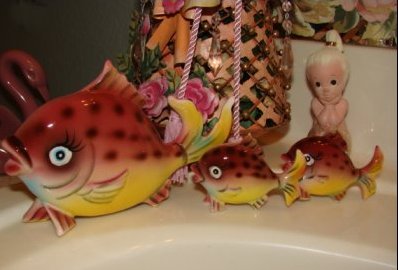
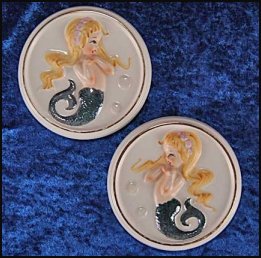
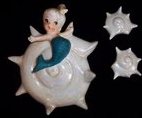 This is a cute mermaid on a spoked shell. She came with two little shells to use rather than bubbles. She always had a blue tailfin although you see that
tailfin repainted a lot for some reason on this one.... maybe so many people liked her but blue didn't fit in their bath decor so they painted the tailfin!
This is a cute mermaid on a spoked shell. She came with two little shells to use rather than bubbles. She always had a blue tailfin although you see that
tailfin repainted a lot for some reason on this one.... maybe so many people liked her but blue didn't fit in their bath decor so they painted the tailfin!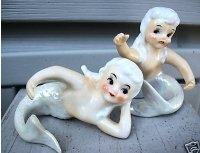 Although these were never distributed by Lefton, I felt compelled to put them here because someone listed them as "Lefton" one time and now everyone seems to be listing
them as such. They have the Japan inkmark on them and were never distributed by Lefton.
Although these were never distributed by Lefton, I felt compelled to put them here because someone listed them as "Lefton" one time and now everyone seems to be listing
them as such. They have the Japan inkmark on them and were never distributed by Lefton. 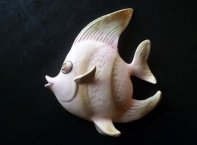 Another Lefton fish. Came as a pair facing each other.
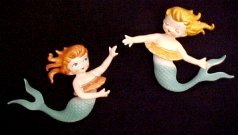
 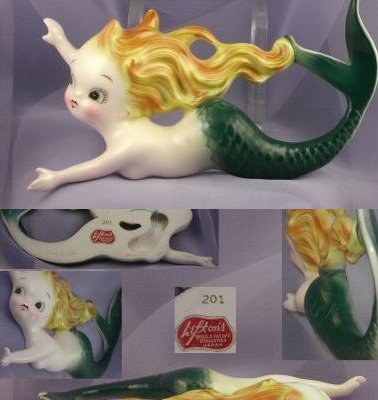 To the left is a beautiful mermaid that looks to be reaching for something. The details are beautiful and colors are vivid. She looks a lot like the PY mermaids, and in fact there is a mermaid
exactly like her but a little larger with the PY marking rather than the Lefton label and 201 numeric marking (see my PY section).
To the left is a beautiful mermaid that looks to be reaching for something. The details are beautiful and colors are vivid. She looks a lot like the PY mermaids, and in fact there is a mermaid
exactly like her but a little larger with the PY marking rather than the Lefton label and 201 numeric marking (see my PY section).