Made by Individuals

Nothing is for sale here, if you want to buy Mermaids, Pixies, Pinups or Vintage Collectibles,  visit my website
Sandy Shores Virtual Mall.

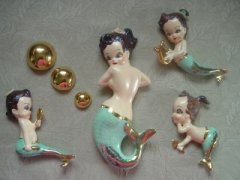
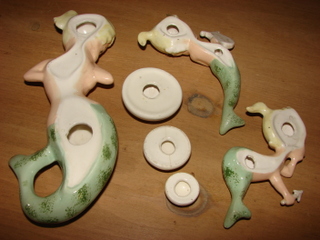
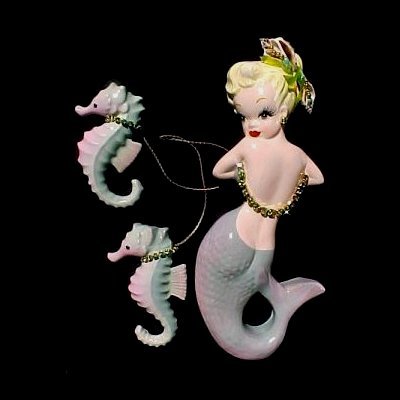
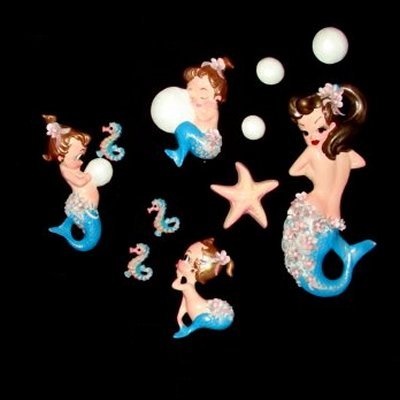
Where are they now....  When I see those mermaid and baby sets with someone's name etched on the back from the 1950's, I often wonder where that person is now and what they thinking when designing the set.  Were they a teenager in ceramics class making a present for mom.  Were they an adult that wanted to make a set to look like their kids so had two with brown hair, one with blonde and then painted mom's hair as the color of their own.  Were they matching their bathroom colors with the colors they painted the tailfins or was it just their favorite color.  Were they on vacation in florida and went into the ceramics shop to kill time while the hubby took the kids to the beach.  Were they a housewife with special artistic talents and this was the only avenue of art they had so they went all out on the seashell/jewel designs on the pieces.  Some weren't signed, probably because they were making it for their house and had no idea it woul be so prized years later by someone else!  Think about it, if the artist was 18 years old back in 1950 making a set, they would be 78 years old now.  Wouldn't it be delightful to take that set you bought and show it to them and tell them how much you value it?  Or find their kids (one of the "babies" in the set) and present them with this set that their mom made of her family.  I guess it's lucky for us they only used their first name so we get to keep the sets and don't feel guilty!  And what about those elaborately designed sets with all the jewels and seashell design on the tailfins - did the artist go on to be a famous designer/artist?   They weren't made in a factory one after another, they were made by individuals just like you and me.  Some were made by an individual that just picked up a paint brush for the first time, some were made by people with a lot of talent.  There were artists back in the 50's that made them for resale just like artists are doing today.  Some were made 50 years ago, some were made the week you bought them. All of them have a "piece" of the person that made them in the set.

Let's look at the term "vintage"... What is "vintage" as it relates to mermaids?  There is no timeline that has been defined for mermaids like there has been for cars, hardware, etc.  So vintage could mean it was made a year ago, 10 years ago, or 50 years ago.  It could even be used as an adjective to describe a newly made piece because it was made from a vintage mold - you often see sellers describing those as "vintage mold mermaid", or "made from a vintage mold."  Some sellers haven't a clue when the piece was made so they just say "vintage." 

How to tell vintage sets from newly made sets... In some cases it is hard to tell because artists selling newly made ones from vintage molds often describe them as "vintage mermaids."  Most artists selling their mermaid sets today state in the description that they made them, or put a copyright disclaimer in the description.  However I  have seen resellers buying the new mermaids and then turning around and selling them as vintage and getting 4 times what the poor artist could get just because people think they should pay more if the item is vintage.  You also see some of these vintage sets that were created really plain with no embellishments have been altered over the years - either for resale purposes or just because someone bought them at a garage sale and wanted them to match their decor better.  The mom/baby walll plaque sets with embellishments it's pretty easy to tell if they are newly made or have been altered over the years. 

*  Back in the 50's they didn't put a top on them, the top was nude.  You didn't see any type of shirt or clothing coming up above the waist.  A couple sets I have seen a bathing suit bra but typically the top is nude. 
*  Back in the 50's they didn't use plastic anything on them, so if you see plastic flowers, feathers, or things that you see that is bought in a fabric store, those are newly made. 
*  Rarely were clay/porcelain flowers applied in the 50's, they used shells to make flower designs - I have only seen 2 vintage sets with a very little clay flower attached to the ponytail band, no huge flowers or multiple flowers attached. 
*  In the 50's the shell design was mostly around the waist - a lot of shells draping down from the waist part and then again on the end of the tailfin - they didn't put a shell flower here and there down the tailfin, the shells were in big groups and alot of them.
*  The 50's sets didn't use jewelry (ie an earring or brooch) for the headpiece design or on the tailfins, the more elaborate ones used single pearls, rhinestones or jewels intermixed in with the shell design. 
*  Hardly any of the 50's vintage wall plaque sets used strings of pearls around the waist, and if they did, they were the hand strung tiny pearls, not the ones you buy in hobby stores that are attached together by machine. 
*  Rhinestone chains were never used for bracelets, necklaces or around the waist on the 50's sets - if rhinestones were applied, they were single rhinestones.   

I'm not poo pooing newly made sets at all, in some cases they look a lot better than some of the vintage sets that were painted by someone that wasn't an artist.  And with newly made sets you can get them in the colors that match your decor.  Heck, I make new mermaids and sell them!  I am only putting down in my writings some information that may be helpful to those of you that want to only look for sets made by individuals back in the 50's.

Molds... There were a number of ceramic mold companies back in the 40's/50's that created molds of mermaids similar to a well known manufacturer's mermaids.  When a manufacturer stopped producing a style, the mold companies then had an open door to reproduce the retired item - the original manufacturer didn't care because it wasn't hurting their profits since they no longer were selling that style.  Ceramic molds were made of the sets in the US for individuals to paint in ceramics class, and Japanese companies started producing sets made of chalkware that had been painted using a spray method rather than hand painting. Mermaids seemed to go out of fashion in the early 60's, and then in the 90's picked up again.  Everyone liked the vintage style so Mold Companies started making new molds of these seacreatures for ceramic, and Deep Flex started making white Plastic molds for individuals to make pieces in chalkware at home.  This has led to a resurge in individuals making mermaids for their own pleasure and resale. Some artists even make their own molds from vintage pieces because there is not a wide variety of  ceramic or plastic molds available to use.   Bottom line to this is that it's sometimes hard to date a piece made by an individual - so buy it because you like it, not for how old it is! 

Ceramic and Plaster...  Ceramic pieces made by individuals could have a fired on color glaze, or it could be painted in acrylic with with a gloss finish.  Most ceramic pieces made in the 50's have fired on colors because they were made in ceramics class where a kiln was available.  But you see a few that were painted in acrylic.  Chalkware is a generic term used for all the plaster types - there over 10 different types of plaster, some more dense than others.  Plaster of Paris is a low cost plaster that can be bought in hobby stores and home depot type stores.  It produces a very fragile, light weight piece.  Whereas, Hydrocal is a gypsum cement type plaster that is close to the density of ceramic and produces a more durable and heavier piece. The seacreatures made back in the 50's out of chalkware used a very dense chalkware and the piece will be heavy (Miller Studio is a good example as all their pieces were made of chalkware).  A newly made chalkware piece it depends on what grade plaster the artist uses how heavy and durable the item is.

Mermaid Mom and Baby sets...  There were two popular vintage family wall plaque sets that consisted of a mom and babies.  One mom had a short ponytail (seen most often in the family sets) and the other one had a long ponytail.  Typically the mom and her babies were created all together back in the 40's/50's.  But now we see alot of single babies or moms being sold that have become separated from their family, or they were newly made as just singles.   

Short Ponytail Mom and 3 Babies

Norcrest was the only manufacturer that made the short ponytail mermaid in ceramic and she came with 2 babies.  The tailfins were ivory color with gold tips - some sets had transparent yellow micro bubbles applied to the tailfins.  The Norcrest mom's tail went to the left. 

You can instantly tell when the Mom was made by an individual because the tailfin goes out to the other side.  The mold companies used different babies too, and they made 3 rather than 2 that Norcrest had with it's familly set. 

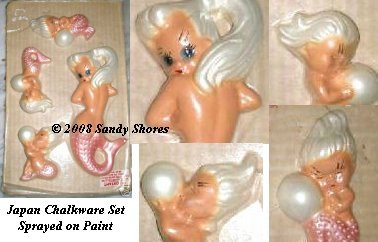
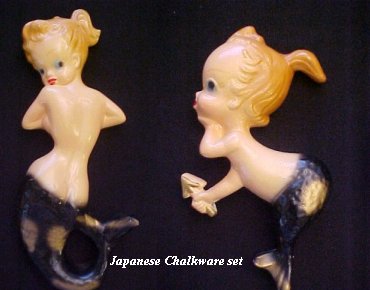
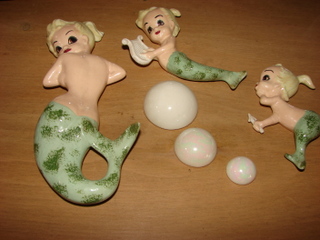
Japan copied the mold of the babies and mom and produced sets in chalkware that had sprayed on paint.  I have not see plastic molds made for this set so if you see any in chalkware that don't have paint sprayed on (ie Japan), they are newly made by individuals making their own rubber or silicone molds of the set. 

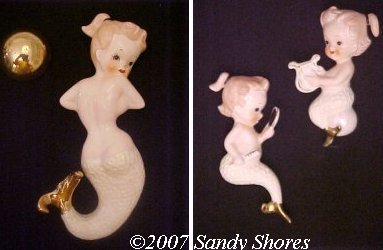
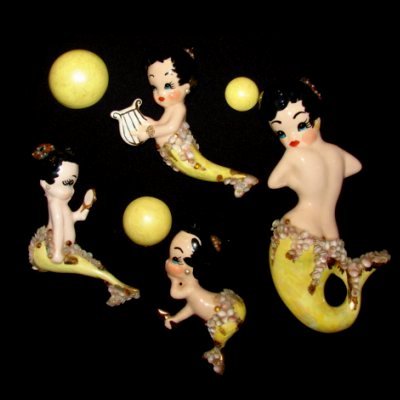
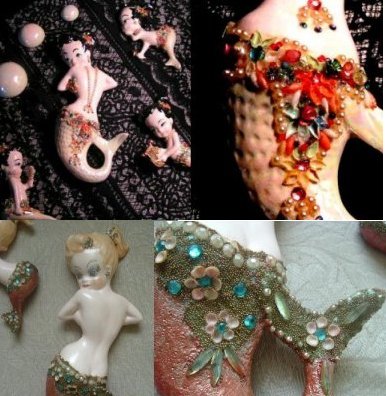
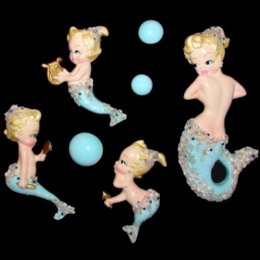
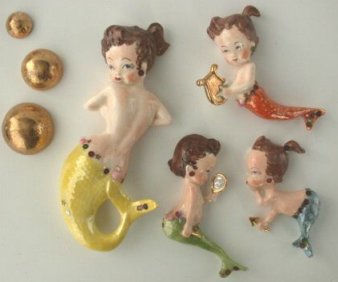
 The pictures below show a set made by Joty (a well known mermaid artist back in the 50's), and a chalkware set made in Japan. Note the lovely shell design on the Joty set.  Shells were a favorite to use as embellishments back then.

 Here are a couple more of designs by artists in the 50's.  The designs to the left not only have shell design but also pearls, jewels and tiny beads.  The set to the right uses rhinestones. There are so many wonderful ways that artists designed these sets but be sure and look at the entire piece.. they may have a nice tailfin design but the faces may lack beauty. 
Long Ponytail Mom and Babies

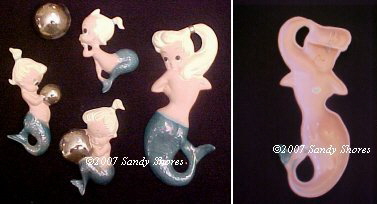
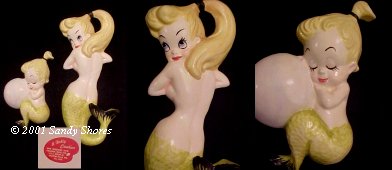
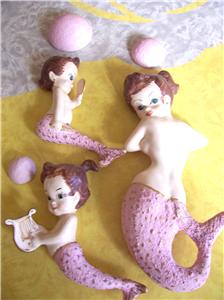
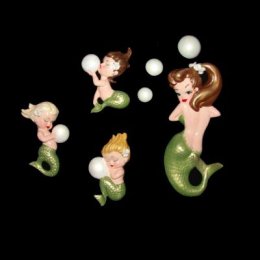
The only manufacturer that made the long ponytail mom in ceramic was Freeman-McFarlin.  She came with 3 babies - two were holding bubbles and one had his hand on his chin.  The set was bisque on the top and gloss on the bottom.  They had no lipstick or blush and only came in green or pink tailfins.  The remake of mom lost a lot of detail - the Freeman-McFarlin mom had real full lips and all the remakes of her have real thin, tiny lips.  You see this long ponytail mermaid by herself alot, I guess because she has a more sexy look than the short ponytail mom and also because she came out in the late 50's after everyone was used to using the short ponytail mom and babies for a "family" set. 

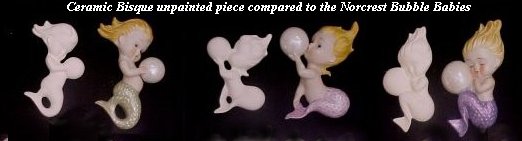
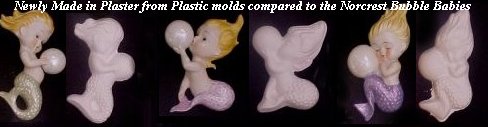
I have seen two vintage Ceramic molds of her.  The Vitrix mold has the 3 bubble babies like Norcrest's babies; the other one had ONE of the Freeman McFarlin Babies (the one with a big bubble).  Below is a comparison of the Norcrest bubble babies with the ceramic bisque ones.  The ones made by individuals are smaller than the Norcrest babies.  Plastic molds have been made of these babies but they really lack a lot of the detail - the new ceramic molds the detail is very good.

Dotty made the set made with the big bubble baby. Dotty was an artist like Joty that made mermaid sets to sell in her gift shop back in the 50's.  This set with the one baby with big bubble was available in both chalkware and ceramic back in the 50's.  Plastic molds have been made of both the mom and the baby.

The 3 baby set with the smaller bubbles made in chalkware are either made in Japan (sprayed on paint) or newly made from plastic molds (ie "vintage mold" mermaid or "made from a vintage mold").


With the rewed interest in mermaids, there continue to be new molds for ceramic and chalkware popping up all the time.  Mold companies are making new molds or them, plastic molds are being made, and artists are making rubber and silicone molds of them.  I have given you some information on the mom/baby wall plaque sets to help you identify vintage vs new because those are the most popular sets people buy.  Just remember when buying vintage mermaids, unless you buy the ones made by manufacturers that have been identified in the reference books, there is no guarantee it is vintage.  A great book to get is Arleen Smith's reference book - Ceramic Fish, Mermaids & Seahorses, Bathroom Decorations of the 1940s & 1950s.  It will serve as a starting point on your journey to collecting mermaids but there are a few mistakes in the book so also educate yourself.  My writings are not meant to take the place of any reference book out there.