|
|
 |
 |
 |
 |
 |
 |
|
Originally a part of the N. Shure Company, a wholesale catalog company, Enesco was established in 1958 as a small import division. When N.
Shure was sold shortly thereafter, the division reorganized as a separate company and began marketing a line of imported giftware. It created its name from the phonetic spelling of its parent company's
initials N.S Co.: Eugene Freedman
was a driving force behind the company since its inception in 1958. He begain his career in 1947 as a salesman for a Milwaukee-based gift and novelty company. He went on to found a gift manufacturing company that made injection molded plastics and decorative figures. In 1958, he sold that business to his partner in order to join Enesco with responsibilities for both sales and overseas product development. Freedman held a variety of management positions prior to being named President and CEO in 1967. He still retains that position with Enesco today. Since the mermaid craze was in the 40's/50's, and Enesco was founded in 1958, that's probably why we don't see many vintage nautical creatures produced by Enesco.
|
|
|
|
|

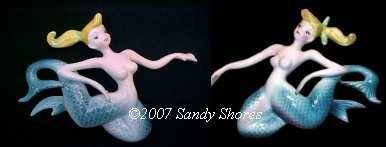
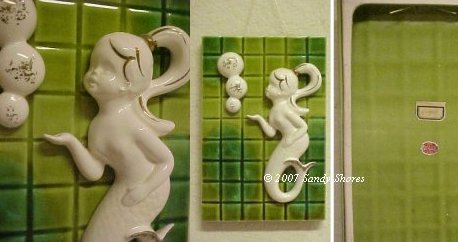
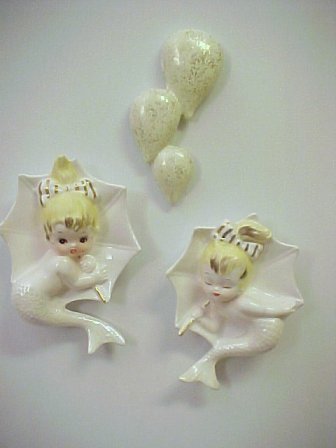
This is a gorgeous mermaid set and although there is no label on either of my pieces, I believe it to be made by Enesco as
they have the same flowing lines and 3-D look of my other Enesco pieces. Plus it has more of an early "60's" look, which would fit right into when Enesco would have been
making these. This is a very delicate set nd on the rare occasions you do find her, more than likely her arms have been broken and repaired, or she has missing parts! But
even with repairs, this is a wonderful mermaid set to own and is very dynamic on the wall.
|
|
|
|

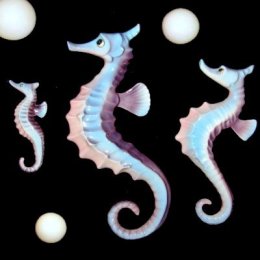
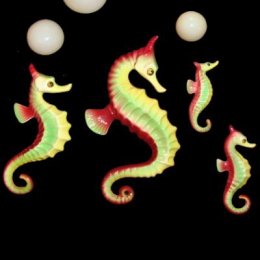
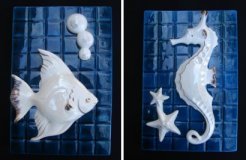
I only have a few nautical pieces of Ensco. Their seahorses were real thin, delicate and flowing. They were very 3D and seemed to come right off the wall at you. Most
seahorse sets are flat to the wall so you only see one eye, the Enesco sets come off the wall from the neck up and you see their entire face. The colors were very vibrant and the
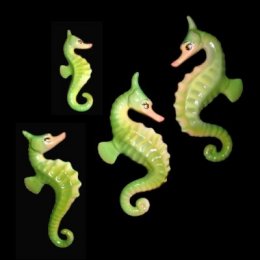
seahorses sets I have with the Enesco label are 3 colors. The two examples show a set in purple/blue/pink and another one in brown/green/yellow. Interesting to note that
Arleen Smith's reference book shows the brown/green/yellow set as made by Kelvin and the sizes documented are an inch larger on each piece than the ones I have. It's
the exact same set, exact shapes and exact same eyes. So you got me on that one.
|
|
|
|